
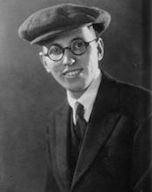
Elmer Rice
Elmer Rice (1892 – 1967) was an American playwright. He is best known for his plays The Adding Machine (1923) and his Pulitzer Prize-winning drama of New York tenement life, Street Scene (1929).
Rice was born in New York City, New York. His grandfather was a political activist in the Revolutions of 1848 in the German states. After the failure of that political upheaval, he emigrated to the United States where he became a businessman. He developed a close relationship with his grandson Elmer, who became a politically motivated writer and shared his grandfather's liberal and pacifist politics. Rice spent much of his youth reading, to his family's consternation, and later observed, "Nothing in my life has been more helpful than the simple act of joining the library."
Because of his need to support his family when his father's epilepsy worsened, Rice did not complete high school, and he took a number of menial jobs before earning his diploma by preparing for the state examinations on his own and then applying to law school. Though he disliked legal studies and spent a good deal of class time reading plays in class (because they could be finished within the span of a two-hour lecture, he said), Rice graduated from New York Law School in 1912 and began a short-lived legal career. Leaving the profession in 1914, he was always to retain a cynical outlook about lawyers, but his two years in a law office provided him with material for several plays, most notably Counsellor-at-Law. (1931). Courtroom dramas became a Rice specialty.
Needing to make a living, he decided to try writing full-time. It was a wise decision. His first play, On Trial, a melodramatic murder mystery, was a great success and ran for 365 performances. Political and social issues occupied Rice's attention in this period as well.